
One of the first questions new kitten owners ask is, "How often should I feed my kitten?"
The answer changes as your kitten grows.
A newborn kitten has very different nutritional needs from a 3-month-old kitten, and a 6-month-old kitten may already be settling into a feeding routine that looks more like an adult cat's schedule.
Understanding your kitten's feeding frequency by age can help you create a routine that supports healthy growth without overfeeding or underfeeding.
In this guide, we'll walk through a practical kitten feeding schedule by age, from newborn kittens through the first year of life. We'll also answer common questions such as:
Is feeding a kitten 2 times a day enough?
Should I feed my kitten 3 times a day?
Can kittens go all night without eating?
Should kittens eat every 8 hours?
When should I reduce my kitten's meal frequency?
What should I do if my kitten is always hungry?
Important: This guide provides general information for healthy kittens. Feeding needs vary according to age, weight, growth rate, breed, health, and the food being fed. Very young, orphaned, underweight, or unwell kittens may need a different feeding schedule under veterinary supervision.
How Often Should a Kitten Eat?
Kittens generally need to eat more frequently than adult cats because they are growing rapidly and have relatively small stomachs.
Instead of eating one or two large meals, young kittens typically benefit from having their daily food allowance divided into several smaller meals.
As kittens mature, their stomach capacity increases. This means that meal frequency can gradually decrease while portions per meal can increase.
However, there is no single feeding schedule that works for every kitten.
Your kitten's ideal routine depends on:
Age
Body weight
Growth rate
Activity level
Breed
Health
Type of food
Calorie density of the food
Individual appetite
The most important thing is to provide an appropriate total daily amount of complete and balanced kitten food, divided into suitable meals.
Kitten Feeding Schedule by Age
The following is a general guide to help you understand how feeding frequency typically changes throughout kittenhood.
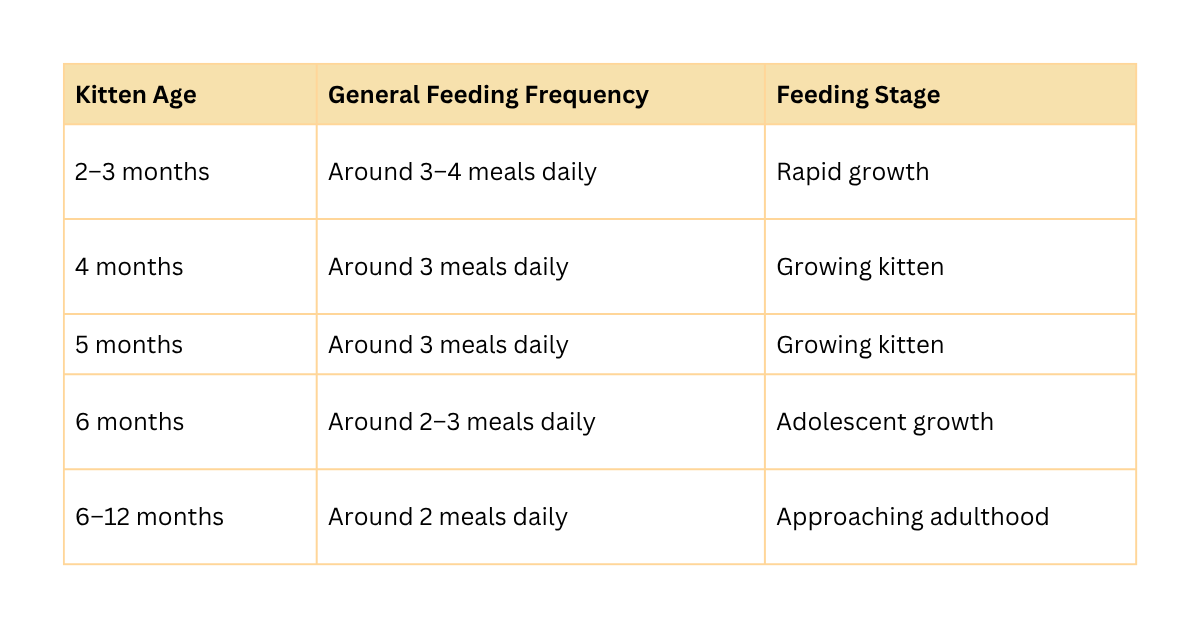
These are general starting points rather than strict rules.
Some kittens may prefer smaller meals more frequently, while others may do well with fewer meals. Very young kittens and kittens with specific health needs may require a different schedule.
2 to 3 Months Old Kitten Feeding Schedule
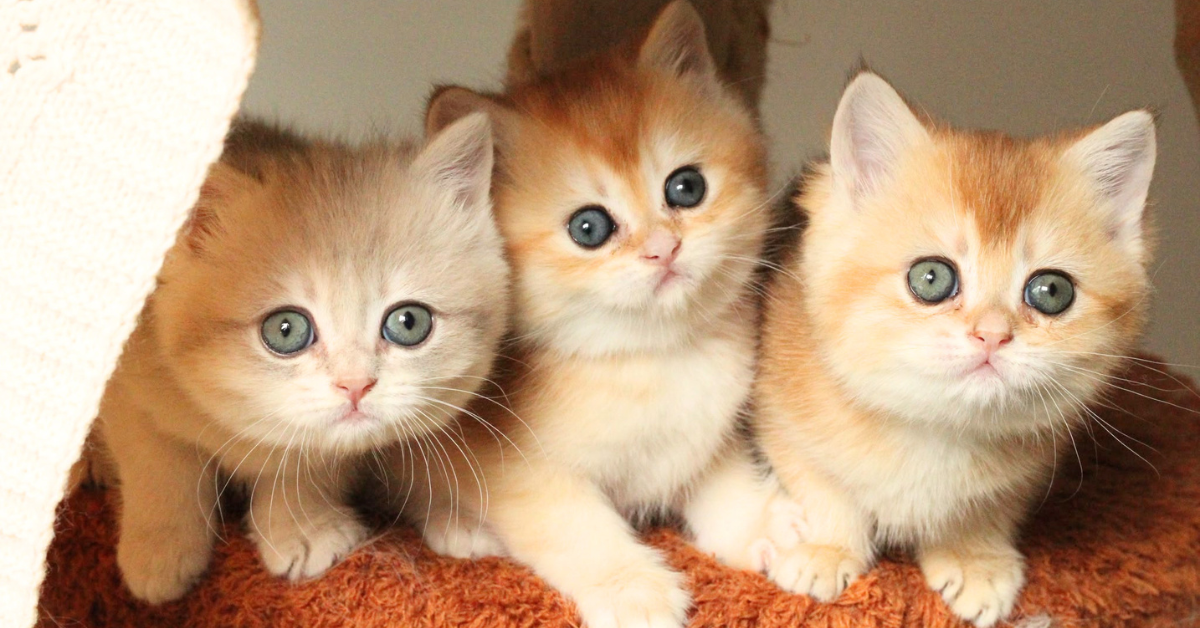
At 2 to 3 months old, many kittens can follow a more predictable routine.
A typical schedule might include:
Breakfast
Midday meal
Evening meal
Optional late-evening meal
Whether you provide three or four meals depends on your kitten's individual needs and the total amount of food they need each day.
If your kitten eats wet food, you may prefer several smaller servings because wet food should not be left sitting out for extended periods.
If feeding dry food, measured portions can make it easier to control the total daily intake.
Kitten Feeding at 4 Months Old
At 4 months old, your kitten is still growing rapidly and generally needs a diet formulated for growth.
Many 4-month-old kittens can be fed around 3 meals per day, such as breakfast, lunch, and dinner.
If your kitten struggles to eat enough during three meals, you may choose to divide the same daily amount into four smaller meals.
At this age, monitor your kitten's:
Weight
Body condition
Appetite
Energy
Growth
A sudden increase or decrease in appetite should be monitored and discussed with your veterinarian if it persists.
Kitten Feeding at 5 Months Old
At 5 months old, kittens are still in an important growth phase. Many can continue with 3 meals per day.
A typical routine might be:
7:00 am — Breakfast
1:00 pm — Lunch
7:00 pm — Dinner
The exact times aren't important as long as the schedule works consistently for you and your kitten.
If your kitten is particularly active or has a smaller appetite per meal, you may choose to offer smaller meals more frequently.
Remember that feeding frequency and feeding quantity are two different things.
If you increase the number of meals, you should generally divide the same appropriate daily food allowance across those meals rather than automatically increasing the total amount.
To understand how much to feed in terms of quantity, check out our guide on How Much Should a Kitten Eat Per Day?
Kitten Feeding at 6 Months Old
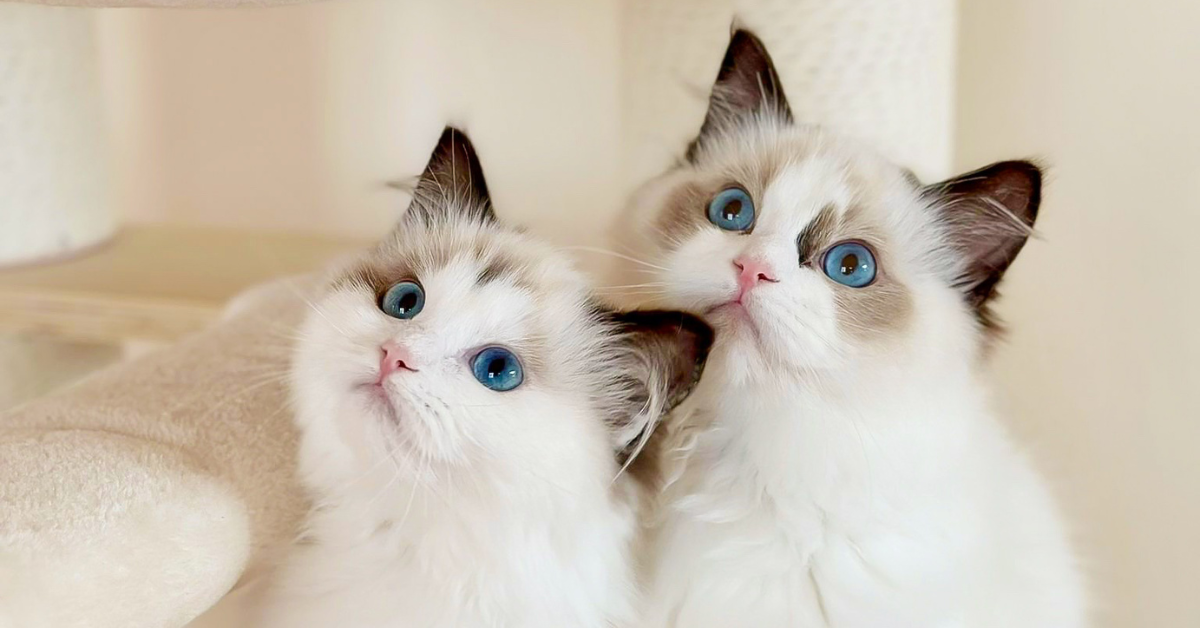
At 6 months old, your kitten is entering adolescence.
Although they may look much bigger than they did a few months earlier, they are still developing and may continue growing for several more months.
Many 6-month-old kittens can start transitioning towards 2 meals per day with a longer time gap in between.
For example:
8:00 am — Breakfast
6:00 pm — Dinner
Some kittens may still benefit from a third meal, particularly if they are very active, have a smaller appetite per meal, or have individual nutritional requirements.
There is no need to rush the transition from three meals to two simply because your kitten has reached six months.
Instead, consider:
Is your kitten maintaining healthy growth?
Are they maintaining an appropriate body condition?
Are they eating their meals comfortably?
Are they constantly hungry?
Are they gaining weight too quickly?
If everything looks healthy, you can gradually establish a feeding routine that works for your household.
Is Feeding a Kitten 2 Times a Day Enough?
For very young kittens, two meals a day may not be enough because they have small stomachs and high nutritional requirements.
For older kittens, particularly those approaching adulthood, two meals a day may be appropriate for some cats.
However, age is not the only factor.
A 6-month-old kitten may do well with two meals, while another may benefit from three smaller meals.
If you feed twice daily, make sure the total daily amount is appropriate and divided between the two meals.
For example:
Daily food allowance: 60g
Meal 1: 30g
Meal 2: 30g
The actual amount should be based on your kitten's food and individual nutritional needs—not this example.
If your kitten struggles to consume enough food in two meals, consider offering smaller meals more frequently.
Is Feeding a Kitten 3 Times a Day Enough?
For many growing kittens, three meals per day can be a practical feeding routine.
Three meals can help spread food throughout the day while still being manageable for most households.
This may work particularly well for kittens between approximately 3 and 6 months, although individual needs vary.
Some younger kittens may need four or more meals, while older kittens may be comfortable with two or three.
When Should You Reduce the Number of Meals?
There is no universal age when every kitten should move from four meals to three or from three meals to two.
A gradual reduction may be considered as your kitten:
Gets older
Has a larger stomach capacity
Can comfortably eat larger portions
Maintains healthy growth
Maintains an appropriate body condition
For example, you might gradually move from 4 meals to 3 meals, then to 2 meals, rather than making an abrupt change.
You can also adjust meal frequency according to your lifestyle.
If your kitten needs three meals but you work during the day, you may consider:
An automatic feeder for appropriate dry food
A timed wet-food feeder designed for pet food
Having a family member or pet sitter provide a meal
Always ensure food is stored safely and that wet food is not left at room temperature for extended periods.
Can Kittens Go All Night Without Eating?
Whether a kitten can safely go overnight without eating depends largely on their age and health.
Very young kittens
Newborn and very young kittens generally require frequent feeding and should not be treated like older cats.
Weaning kittens
Young kittens transitioning to solid food may still need several meals spread throughout the day.
Older, healthy kittens
Older kittens may be able to sleep through the night between meals, particularly if they have eaten an appropriate evening meal and are otherwise healthy.
However, there is no universal rule that applies to every kitten.
If your kitten is very young, underweight, unwell, or has been advised to follow a specific feeding schedule, consult your veterinarian before allowing a long overnight gap.
Should Kittens Eat Every 8 Hours?
Not necessarily.
An 8-hour interval simply means a kitten is eating three times in a 24-hour period.
However, this doesn't mean that every kitten should be fed exactly every eight hours.
Meal timing depends on:
Age
Total daily food requirements
Individual appetite
Food type
Health
Household routine
A younger kitten may benefit from meals spaced more closely together.
An older kitten may be comfortable with a longer overnight interval.
Instead of focusing strictly on an eight-hour rule, focus on providing an appropriate total daily intake divided into suitable meals.
Can a Kitten Go 8 Hours Without Eating?
The answer depends on the kitten.
A healthy older kitten may be able to go around eight hours between meals, particularly overnight.
However, this should not automatically be applied to newborn or very young kittens.
Young kittens have smaller stomachs and higher feeding frequency requirements. Going too long without food can be more concerning in a very young, small, underweight, or sick kitten.
If your kitten has suddenly stopped eating or refuses multiple meals, do not assume that they are simply not hungry.
Monitor them closely and seek veterinary advice if the lack of appetite persists or is accompanied by other symptoms.
For a deeper dive, see our guide Can a Kitten Go 8 Hours Without Eating? A Guide to Overnight Feeding & Leaving Kittens Alone
What If My Kitten Is Always Hungry?
Some kittens are naturally enthusiastic eaters.
However, constantly appearing hungry can have several explanations.
Your kitten may:
Be going through a growth spurt
Need a different feeding schedule
Be receiving insufficient calories
Be eating food with a different calorie density
Be seeking attention
Be bored
Have developed a habit of asking for food
Before simply increasing the amount you feed, check your kitten's:
Current weight
Growth pattern
Body condition
Daily calorie intake
Food type
If your kitten is constantly hungry while losing weight, has persistent diarrhoea, vomits, or shows other unusual symptoms, speak to your veterinarian.
Conversely, if your kitten is always hungry while their condition is normal, be cautious about overfeeding them. Learn the signs of overfeeding with our guide How to Tell If Your Kitten Is Overfed—and When to Stop Feeding Kitten Food
What If My Kitten Doesn't Finish Their Meal?
Not finishing one meal doesn't necessarily mean something is wrong.
Your kitten may simply be less hungry at that particular meal.
However, pay attention to patterns.
If your kitten consistently leaves food behind, consider:
Whether the portion is too large
Whether the food is fresh
Whether the food is being served at a comfortable temperature
Whether your kitten prefers a different texture
Whether the bowl is comfortable
Whether there have been changes in the environment
If your kitten suddenly loses interest in food or refuses multiple meals, take the change seriously and contact your veterinarian if needed.
Should I Feed My Kitten Before Bed?
An evening meal can be useful for some kittens, particularly if they are on a three or four-meal schedule.
A meal before bedtime may help fit the kitten's daily food allowance into the day's routine and reduce the gap between dinner and breakfast.
However, a bedtime meal does not necessarily mean your kitten needs to be fed throughout the night.
The appropriate schedule depends on your kitten's age and individual needs.
For very young kittens, follow veterinary guidance regarding overnight feeding.
How to Build a Kitten Feeding Routine That Works

The best feeding routine is one that is:
Appropriate for your kitten + Consistent + Sustainable for your household
Start with your kitten's nutritional needs.
Then build the schedule around your lifestyle.
Step 1: Determine the Daily Food Allowance
Use the feeding instructions for your kitten's specific food.
Step 2: Choose the Number of Meals
Base this on your kitten's age and individual needs.
Step 3: Divide the Daily Amount
Split the total daily amount across the meals.
Step 4: Establish Consistent Times
Choose meal times that you can realistically maintain.
Step 5: Monitor Your Kitten
Track:
Weight
Appetite
Energy
Body condition
Stool
Step 6: Adjust as Your Kitten Grows
Your kitten's feeding routine will likely need to change over time.
Sample Kitten Feeding Schedule
This example is designed to demonstrate how meal frequency can change with age.
They are not intended to prescribe a specific amount of food.
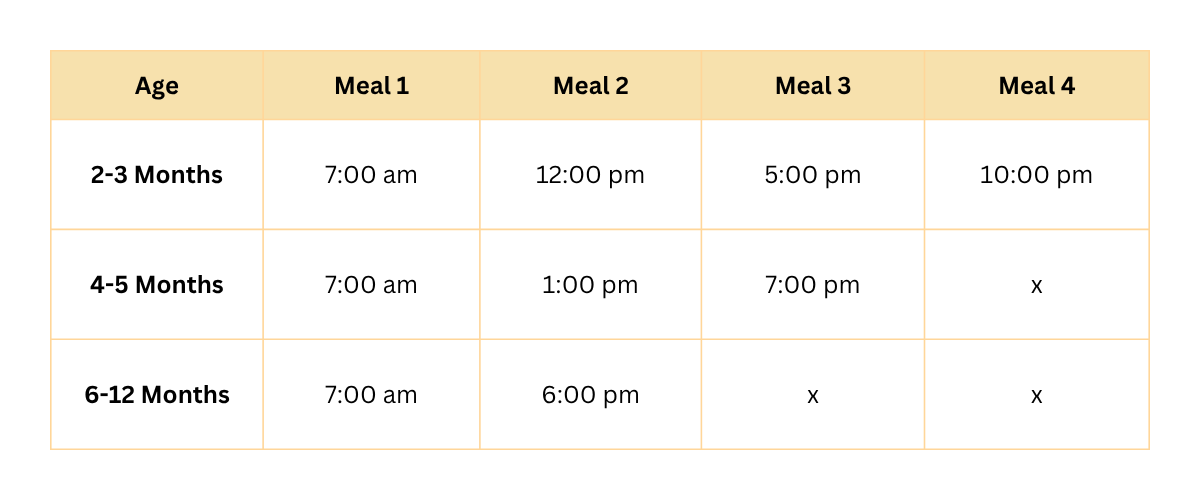
The right choice depends on your kitten's appetite, nutritional needs, and individual development.
The Bottom Line: How Often Should Your Kitten Eat?
There is no single feeding schedule that works for every kitten.
As a general guide:
2–3-month-old kittens often benefit from around 3–4 meals daily.
4–5-month-old kittens often do well with around 3 meals daily.
6-month-old kittens may gradually transition towards 2–3 meals daily.
Older kittens can often move towards a more adult-style feeding routine as they approach maturity.
The goal isn't simply to feed your kitten a certain number of times each day.
The goal is to provide the right amount of complete nutrition, at an appropriate frequency, while supporting healthy growth.
Monitor your kitten's weight, body condition, appetite, and behaviour, and adjust their feeding plan as they grow.
Not sure how much and what to feed them? Check out our guide The Complete Kitten Feeding Guide by Age & Weight.
FAQ
-
A 2-month-old kitten will often do well with around 3–4 meals per day, although individual needs vary. Very small or underweight kittens may need more frequent feeding.
-
Two meals may be suitable for some older kittens, but it may not be enough for very young kittens. Younger kittens generally benefit from more frequent meals because they have smaller stomachs and are growing rapidly.
-
For many kittens between approximately 3 and 6 months, three meals per day can be a practical routine. However, younger kittens may need more frequent meals, while some older kittens may be comfortable with two meals.
-
Older, healthy kittens may be able to sleep through the night without eating. However, newborn and very young kittens generally require more frequent feeding. If you're unsure about your kitten's overnight feeding needs, consult your veterinarian.
-
Not necessarily. An 8-hour interval is one possible schedule for an older kitten, but younger kittens may need meals spaced closer together. Focus on your kitten's age, total daily food intake, and individual needs rather than following a strict eight-hour rule.
-
An older, healthy kitten may be able to go around eight hours between meals, particularly overnight. However, very young, underweight, or unwell kittens may need more frequent feeding.
-
First, consider your kitten's age. A very young kitten may genuinely need more frequent meals. For an older kitten, waking you may be related to habit, attention-seeking, boredom, or hunger.
Ensure your kitten is receiving an appropriate total daily food allowance and has adequate play and enrichment during the day.
-
There is no fixed age when every kitten should switch to two meals. Many kittens can gradually move towards two or three meals per day as they approach six months and beyond, but individual needs vary.
-
Free-feeding may work for some cats, but it can make it difficult to monitor exactly how much your kitten is eating and may contribute to excessive calorie intake in some cats.
Measured portions and scheduled meals can make monitoring easier.
-
Check your kitten's food quantity, calorie intake, weight, and body condition. Growing kittens can have high energy needs, but persistent hunger can sometimes indicate a health issue.
If your kitten is constantly hungry while losing weight or showing other unusual symptoms, contact your veterinarian.
-
Monitor their weight, growth, body condition, energy levels, and appetite. Your kitten should ideally follow a healthy growth pattern rather than simply reaching a specific weight at a specific age.
If you're concerned about your kitten's growth or feeding quantity, ask your veterinarian to assess them.

